
Replace Klaviyo With a Custom Tool: The Real Cost Math
Klaviyo does not bill you for the emails you send. It bills you for the contacts you keep. Since 18 February 2025, every reachable profile in your account counts toward your tier, whether you have emailed them this year or not.
That single design choice is why a store at 25,000 profiles pays $400 a month while the same store at 10,000 pays $150. Same features. Same flows. A 167% price increase for contacts that, in most accounts I audit, are producing close to zero revenue.
Across the SaaS replacement builds in my consulting practice, recurring tool spend drops by an average of 71% with a typical payback inside 7 months. But this post is not a pitch. I am going to show you the free fix you should try before you pay anyone anything, and I am going to show you the exact conditions under which building is the wrong call.
Why did my Klaviyo bill go up when my revenue didn’t?
Because Klaviyo prices on list size, and list size is the one metric that only moves in one direction. Your bill is indexed to how many contacts you store. Your revenue is indexed to how many contacts you reach. Those two numbers diverge every month, and the gap between them is your overpayment.
Before February 2025, Klaviyo counted only the profiles you actually emailed. After that date, billing moved to all active profiles: anyone still reachable by email, SMS, or push. A store with 20,000 contacts that emails 8,000 of them now pays at the 20,000 tier.
Three mechanics make this worse than it first looks, and almost nobody catches all three:
- Auto-upgrade is on. Auto-downgrade is not. Your list spikes during a Black Friday popup blitz, Klaviyo bumps your tier, and when the list settles back down the tier stays where it is. You keep paying the higher rate until you manually go into billing and step it down.
- Unsuppressing a contact locks them into your bill for 90 days. Once you unsuppress a profile, you cannot re-suppress it for three months. That contact is billable whether you touch them or not.
- The add-on surface keeps expanding. Reviews starts around $25/month. Marketing Analytics starts near $100/month at 13,500 profiles. The Advanced Klaviyo Data Platform runs $500/month. Customer Agent carries a base subscription plus roughly $0.70 per conversation past the included 50. The base email tier is relatively stable. The things bolted onto it are not.
The result is a bill indexed to the size of your CRM database rather than to your marketing performance. For a $3M DTC brand that is $500 to $900 a month for infrastructure whose marginal cost to Klaviyo is close to zero.
What are you actually paying Klaviyo for?
You are paying for four separate products fused into one invoice: a profile store, a segmentation and predictive AI layer, a flow orchestrator, and sending infrastructure with managed deliverability. Only the first three are worth rebuilding. The fourth you should rent, not build, and that distinction is the whole game.
Break the platform apart and it looks like this:
| Layer | What it does | Rebuild or rent? |
|---|---|---|
| Profile store (CDP) | Holds contacts, events, order history, consent state | Rebuild. It is a Postgres database. |
| Segmentation + predictive AI | CLV predictions, churn risk, AI segments, send-time optimization, generated copy | Rebuild. Standard applied ML, and where Klaviyo’s margin lives. |
| Flow orchestration | Triggers, delays, branches, throttles | Rebuild. A queue, a scheduler, and a state machine. |
| Sending + deliverability | SPF/DKIM/DMARC, IP warmup, bounce and complaint handling, feedback loops | Rent. Do not touch this. |
Here is the part most “ditch your SaaS” posts get wrong, and it matters: Klaviyo’s deliverability infrastructure is genuinely worth money. Sender reputation, Gmail and Yahoo feedback loops, and the bulk sender requirements enforced since 2024 (DMARC, one-click unsubscribe, spam complaint rates under 0.3%) represent real engineering built over real years.
But you are not paying for that by the profile. You are paying by the profile because that is how a venture-scale SaaS captures value, not because storing a dead contact costs Klaviyo money. And you can buy that same sending infrastructure directly. Amazon SES sells it at $0.10 per 1,000 emails with no base fee. Postmark sells it from around $15/month for 10,000 sends with best-in-class inbox placement.
The arbitrage is precise: the layers Klaviyo charges the highest premium for are the layers cheapest for you to reproduce, and the one layer that is genuinely hard is the one you can rent for pennies.
Can a custom tool really replace Klaviyo, or is that a fantasy?
Yes, for three of the four layers, and those three account for most of the bill. The realistic architecture is a Postgres profile store, a Python job runner for segmentation and ML scoring, a code-defined flow engine, and Amazon SES or Postmark underneath for delivery. Nothing in that stack is exotic.
The concrete build looks like this:
- Profile and event store: Postgres (Supabase or RDS). Shopify webhooks write orders, checkouts, and browse events straight in. Your consent state and suppression list live here, and they are yours.
- Segmentation: SQL. Klaviyo’s segment builder is a drag-and-drop interface over queries you could write in a text editor. “Purchased twice in 90 days, opened in 30, not in the VIP tier” is nine lines of SQL.
- Flow engine: a job queue and scheduler running flow definitions from a config file. Abandoned checkout, browse abandonment, post-purchase, winback, replenishment. That is five flows, and it is roughly 90% of what a DTC brand actually runs.
- Sending: SES for volume, or Postmark if inbox placement on transactional messages justifies the premium.
- The AI layer: covered in detail below, because that is where the money is.
What you give up is real, and I will name it: the polished visual editor, the 350+ prebuilt integrations, the industry benchmark data, and a vendor whose job it is to answer your ticket at 2am. If those matter more to you than $600 a month, stay on Klaviyo. That is a legitimate decision, not a failure of nerve.
What does a custom Klaviyo replacement actually cost to run?
Between $50 and $360 per month in infrastructure, depending on list size and send volume. Sending dominates and it is cheap: 250,000 emails a month through Amazon SES costs $25. Database, compute, and ML scoring add another $50 to $70 combined. There are no per-contact charges anywhere in the stack.
Here is the three-year math using Klaviyo’s public email-only tiers, cross-checked against multiple independent audits of their pricing slider through mid-2026. Klaviyo adjusts tiers periodically, so confirm the live slider against your own account before you budget anything.
| Active profiles | Klaviyo (email-only) | 3-yr Klaviyo | Custom stack /mo | One-off build | 3-yr custom (build + run) | 3-yr difference |
|---|---|---|---|---|---|---|
| 10,000 | $150/mo | $5,400 | ~$50 | $3,500 | $5,300 | ~$100. A wash. |
| 25,000 | $400/mo | $14,400 | ~$70 | $4,000 | $6,520 | ~$7,900 |
| 50,000 | $720/mo | $25,920 | ~$95 | $5,500 | $8,920 | ~$17,000 |
| 250,000 | $2,300/mo | $82,800 | ~$360 | $8,000 | $21,000 | ~$61,800 |
Look at the first row, because it is the most useful row in this post. At 10,000 profiles, three years of custom build saves you roughly $100. That is a rounding error. On those numbers alone you would be taking on deliverability risk and maintenance responsibility to save about $2.80 a month.
Payback periods tell the same story. At 25,000 profiles you recover the build cost in about 12 months. At 50,000 it is roughly 9 months. At 250,000 it is around 4 months. At 10,000 it is nearly 3 years.
But that table has a hidden assumption, and it is doing enormous work. It assumes your list never grows and you close the business in three years. Neither is true for most people reading this, which is why the next section exists.
Why does the three-year table understate the real saving?
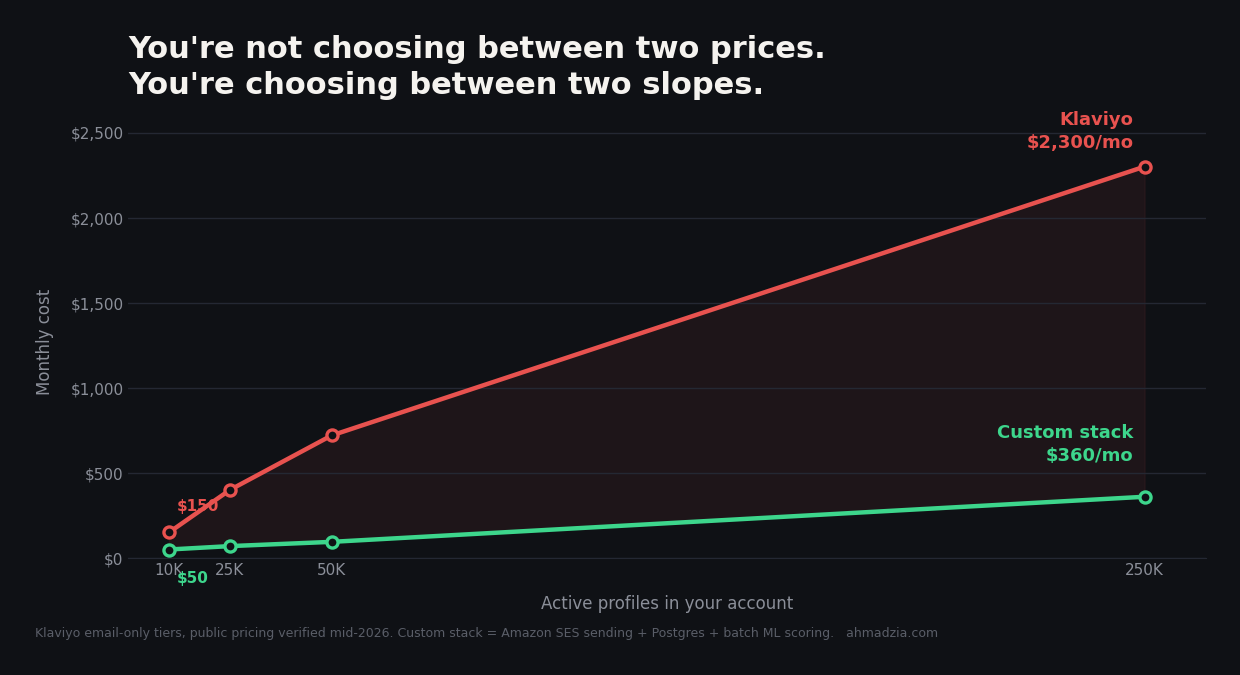
Because the two cost curves have different slopes. Klaviyo’s price is a function of list size, which grows every month. A custom stack’s price is a function of send volume, which grows far more slowly, because storing 40,000 extra contact rows in Postgres costs approximately nothing. You are not choosing between two prices. You are choosing between two slopes.
Watch what happens to each column as a store grows from 10,000 to 50,000 profiles:
- Klaviyo: $150 → $720/month. A 4.8x increase.
- Custom stack: ~$50 → ~$95/month. A 1.9x increase, and almost all of that is sending volume, not contacts.
That divergence compounds, and it compounds in two directions at once.
Direction one: the build cost is paid, once, forever. After payback, every subsequent month is pure delta. A build that breaks even at month 12 is generating savings for months 13 through infinity with no further capital outlay. Klaviyo, by design, never stops charging. Run the same table over five years instead of three and the 10,000-profile row stops being a wash:
| Active profiles | 5-yr Klaviyo | 5-yr custom (build + run) | 5-yr difference |
|---|---|---|---|
| 10,000 | $9,000 | $6,500 | ~$2,500 |
| 25,000 | $24,000 | $8,200 | ~$15,800 |
| 50,000 | $43,200 | $11,200 | ~$32,000 |
| 250,000 | $138,000 | $29,600 | ~$108,400 |
Direction two, and this is the bigger one: your list is not static. A healthy DTC brand adds profiles every single month. Take a store sitting at 10,000 profiles today, the exact tier where the static table said “do not build,” and grow it at a modest 50% a year:
| Year | Profiles (end) | Klaviyo (year) | Custom stack (year) |
|---|---|---|---|
| 1 | 15,000 | ~$2,400 | ~$600 |
| 2 | 22,500 | ~$3,600 | ~$660 |
| 3 | 33,750 | ~$5,400 | ~$780 |
| 4 | 50,600 | ~$7,440 | ~$960 |
| 5 | 76,000 | ~$10,200 | ~$1,200 |
| Total | ~$29,040 | ~$4,200 + $3,500 build = $7,700 |
Five-year difference: roughly $21,300. Three-year difference on the same growth path: about $5,900, not the $100 the static table predicted.
The static table is the worst case. It describes a store whose list is frozen and whose owner shuts the doors in 36 months. If your list genuinely never grows, you have a larger problem than your Klaviyo bill, and this post is not the one you need.
There is a third compounding effect worth naming. On a custom stack, a dead profile costs you nothing, so list hygiene stops being a billing chore. On Klaviyo it is a permanent treadmill: suppress quarterly, remember to manually downgrade your tier, repeat forever, and eat the cost every quarter you forget. Cleaning your list is a real fix, but it is a fix you have to keep re-applying.
One more adjustment pushes the math hard toward building: the add-ons. Every table above is email-only. If you also carry Reviews, Marketing Analytics, the Advanced Data Platform, or Customer Agent, you are paying premium rates for exactly the layers that are cheapest to reproduce. A store at 15,000 profiles paying $150 for email plus $100 for analytics plus $200 for an AI agent is at $450/month, and the build now makes sense at a list size where the email-only math said otherwise.
How do you build the AI layer Klaviyo charges a premium for?
By using the same open-source methods Klaviyo uses under the hood, run as scheduled batch jobs instead of billed API calls. Predictive CLV, churn scoring, send-time optimization, and copy generation are all mature, well-documented techniques with solid open-source implementations. None of them require a per-profile subscription.
This is where the “AI” premium evaporates, so let me name the actual methods rather than gesturing at “AI tools.”
Predictive CLV and churn risk. Klaviyo’s predictive analytics are, underneath, two standard approaches. Probabilistic CLV uses BG/NBD paired with a Gamma-Gamma model over purchase history, available in the lifetimes library and trainable on a laptop in under a minute. Churn and repeat-purchase probability use gradient boosting (LightGBM or XGBoost) over RFM features. Both score your entire list nightly for cents of compute.
Send-time optimization. Build a per-recipient open-hour histogram from engagement events, then use a multi-armed bandit (Thompson sampling works well) so the model keeps exploring rather than locking into a stale pattern. This is roughly a hundred lines of Python. It is a technique, not a product feature.
Product recommendations. Item-item collaborative filtering with implicit ALS, or sentence-transformer embeddings over your catalogue with pgvector for retrieval. Both run inside the Postgres instance you are already paying for.
Copy generation. This is where I lean on my green ML research. Rather than paying per token to a frontier API, run a quantized open-weight model such as Llama 3.1 8B, Mistral 7B, or Qwen 2.5 7B, LoRA fine-tuned on your best-performing past campaigns. Your brand voice comes from your own winners instead of a generic prompt. Generation runs as a batch job when you build a campaign, not as a live request on every send, which is why the compute line stays under $15/month. The same principle drives the AI API Independence Engagement, where migrating production workloads off metered APIs typically cuts AI infrastructure cost by 80 to 95%.
The green ML discipline matters here for an unsentimental reason. Batch inference on a right-sized 7B model instead of per-request calls to a frontier API is exactly what keeps a custom stack at $95/month rather than $400/month. Get that wrong and you have rebuilt Klaviyo’s bill with extra steps and worse support.
If the AI layer is the only piece you want to own, that is a narrower and cheaper engagement. The custom AI email marketing engine rebuilds segmentation, prediction, and copy generation while leaving your existing sending infrastructure untouched.
How do you migrate off Klaviyo without destroying your deliverability?
Slowly, in parallel, and starting with your suppression list. The fastest way to burn a sending domain is to migrate without your unsubscribe and bounce records and then email people who already opted out. Budget 8 to 10 weeks end to end: 3 to 4 weeks to build, plus 4 to 6 weeks of domain warmup running alongside Klaviyo.
The sequence that works:
- Export everything, suppression list first. Profiles, events, flow definitions, template HTML, and the complete suppression and bounce record via the Klaviyo API. Losing suppression data is not merely a deliverability problem, it is a CAN-SPAM and GDPR problem. Verify the export before you touch anything else.
- Warm a dedicated sending subdomain. Send from
mail.yourstore.comwith its own DMARC policy so your corporate mail stays insulated. Start with your most engaged 30-day segment at low volume and ramp over 4 to 6 weeks. New SES accounts start in sandbox, so file the production access request on day one. - Wire bounce and complaint handling before your first send. SES routes these events to SNS and expects you to process them. This is the step people skip, and SES will suspend sending if your bounce rate crosses roughly 10%. Set a CloudWatch alarm at 5% so you get a warning instead of an outage.
- Run both systems side by side for 2 to 4 weeks. Split each flow’s audience. Compare revenue per recipient, not open rate. Open rate has been noise since Apple Mail Privacy Protection.
- Cut over one flow at a time, lowest risk first. Browse abandonment first. Abandoned checkout last, because it is usually the highest-revenue flow you own. Cancel the Klaviyo subscription only after 30 days of matched or better revenue per recipient.
That last step is a discipline, not a formality. Every SaaS replacement build I run includes a parallel period specifically so the decision to cancel gets made on data rather than on hope.
When is replacing Klaviyo actually a bad idea?
When your time horizon is short, when your list is flat, or when nobody on your team can read a log file. This is not purely a size question. It is a size-times-horizon question, and the horizon is the variable people get wrong. A build is a capital expense that pays back over 9 to 14 months and then compounds. If you cannot confidently say you will still be running this store in two years, rent, do not buy.
The four honest no-go conditions:
- Short horizon. Selling the business inside 24 months, or genuinely unsure the store survives that long? The build never reaches payback and you have spent capital for nothing. Stay on Klaviyo. This is the single most common reason I tell someone no.
- Flat list under 10,000 profiles. If your list is not growing and you are under $300/month, the money does not come back fast enough to be worth the operational risk. Note the word flat: a growing 10,000-profile list is a completely different case, as the tables above show.
- No technical capacity at all. If nobody internally can read a log file or notice a bounce-rate alarm, you are trading a vendor dependency for a dependency on whoever built your tool. That may still be an improvement, but be honest that it is a trade and not an escape.
- You are weeks from Black Friday. Do not migrate sending infrastructure inside your highest-revenue window. The answer is not never, it is not now.
And try the free fix first. Before you talk to anyone about a build, do this: suppress every profile with no engagement in 12 months, then go into Klaviyo billing and manually step your tier down. Most accounts I audit carry 30 to 50% dead weight. On a $720/month bill at 50,000 profiles, dropping to 30,000 real profiles can cut $250 or more off your monthly invoice for an afternoon of work. That costs you nothing and it costs me a client. It is still the right first move.
The mistake I see most inside custom builds. People try to rebuild the drag-and-drop flow canvas. That visual editor is maybe 60% of the engineering effort and close to 0% of the value, because you have seven flows and you edit them twice a year. Define flows in a config file. Boring wins. A build that spends its budget on a pretty UI instead of on the ML layer produces a worse tool at twice the price.
And a fair warning about what you take on. Sender reputation becomes your responsibility. Google and Yahoo’s bulk sender rules are not optional. If your spam complaint rate drifts above 0.3%, inbox placement degrades and it is on you to notice. That is manageable. It is not free. Any consultant who tells you otherwise is selling you something.
What should you do in the next 90 days?
If your Klaviyo bill is above $400/month, your list is growing, and you plan to still be trading in three years, the calendar is now the binding constraint. The build takes 3 to 4 weeks. Domain warmup takes another 4 to 6. Starting in July means parallel-running through September and cutting over cleanly in October, before the Q4 signup surge auto-upgrades your tier for another year.
That is arithmetic, not manufactured urgency. Your list only grows. Klaviyo’s tier ladder only steps up. Every month you defer, two things happen: the bill you are migrating away from is larger, and the year-four savings you have not started earning yet slide a month further out.
The honest ordering:
- This week, free: suppress your 12-month non-engagers and manually step your billing tier down. If that gets you under $300/month and your list is flat, you are done. Close the tab.
- This month, free: pull your real numbers. Total active profiles, month-over-month list growth rate, monthly send volume, and every add-on line item. Those four figures are the entire input to the decision.
- If your all-in bill is above $400/month and your list is growing: the three-year math almost certainly favours a build, and the five-year math is not close. The Ecommerce SaaS Replacement Build exists for exactly this. Scope it in July, own it by October.
Frequently Asked Questions
How much does Klaviyo cost per month in 2026?
Klaviyo’s email plan starts at $20/month for 251 to 500 active profiles and scales with list size: roughly $30 at 1,000 profiles, $150 at 10,000, $400 at 25,000, $720 at 50,000, and $2,300 at 250,000. SMS is billed separately on a credit system. Add-ons including Reviews, Marketing Analytics, the Advanced Data Platform, and Customer Agent are charged on top. Feature sets are identical across paid tiers; you pay more purely because your list is bigger.
Can you actually replace Klaviyo with a custom tool?
You can replace three of its four layers. The profile store, the segmentation and predictive AI layer, and the flow orchestrator are standard engineering and rebuild cleanly in Python and Postgres. The sending and deliverability layer should be rented from Amazon SES or Postmark rather than rebuilt, because sender reputation infrastructure is genuinely hard and genuinely cheap to buy. A custom stack running all four typically costs $50 to $360 per month.
At what list size does replacing Klaviyo stop making sense?
It depends on your time horizon more than your list size. A flat list under 10,000 profiles at under $300/month is not worth building for: the three-year saving is around $100. But a growing 10,000-profile list is a different case entirely, because Klaviyo’s cost curve rises with contacts while a custom stack’s stays nearly flat. A store growing 50% a year from 10,000 profiles saves roughly $5,900 over three years and $21,000 over five.
Does a custom email tool still save money after the build is paid off?
Yes, and this is where most of the value sits. The build is a one-time capital cost that typically reaches payback in 9 to 14 months. Every month after that is pure saving against a Klaviyo subscription that never stops charging and rises as your list grows. Over five years at 50,000 profiles, the difference is roughly $32,000 rather than the $17,000 the three-year table shows.
Is Amazon SES good enough for ecommerce marketing email?
Yes, provided you handle the operational work SES leaves to you. SES charges $0.10 per 1,000 emails with no base fee and runs on the same infrastructure Amazon uses for its own mail. What it does not give you is a campaign builder, a bounce dashboard, or automatic complaint handling. You wire bounce and complaint events yourself, warm your own sending domain, and monitor your own reputation. Postmark costs more and handles more of that for you.
Why did Klaviyo raise my bill when I did not add contacts?
Most likely a tier that auto-upgraded and never came back down. Klaviyo bumps your plan when active profiles cross a threshold, but it does not automatically step you back down when the count falls. If you ran a popup campaign or a giveaway, your tier moved up and stayed there. Check billing after every list cleanup and after every major campaign, and turn on the auto-downgrade preference, which is off by default.
How long does a custom Klaviyo replacement take to build?
Three to four weeks for the build, plus four to six weeks of domain warmup and parallel running before you cancel the subscription. Call it 8 to 10 weeks end to end. Rushing the warmup is the most common way these projects fail, because a cold sending domain pushed to full volume lands in spam and you spend weeks recovering reputation you could have built gradually.
What happens to my data if I build a custom email tool?
It lives in your own Postgres database and stays yours permanently. Every profile, event, order, and consent record sits in infrastructure you control, exportable at any time, with no vendor able to paywall access or change the terms. That is the durable difference between owning a tool and renting one: after three years of Klaviyo you have receipts, and after three years of an owned stack you have an asset that keeps paying.
Want the honest version of this math for your own account?
Run the free fix first. Suppress your dead profiles, step your tier down, and see where the bill lands. If it comes out under $300 a month and your list is flat, you do not need me, and I will say so on the call.
If it is still above $400, your list is growing, and you want a tool that does your specific job at infrastructure rates rather than subscription rates and belongs to you afterwards, that is exactly what the Ecommerce SaaS Replacement Build is for. Bring four numbers to a free 20-minute discovery call: your active profile count, your monthly list growth rate, your send volume, and your add-on line items. I will run the three-year and five-year numbers for your account before either of us commits to anything.